Showing posts with label Saminaka African Festival. Show all posts

Wednesday, October 14, 2009

FROM THE SUITCASE--Oliha Yiwama

Jammin' with Spirit


Wow! Saminaka had a great African festival last week--masquerades, music, drums, dance, cultural attire and talks. We had a record participation from our guests as well. I want to congratulate the new members of the African Mystics for embarking on their spiritual journey. Last but certainly not least, I'd like to congratulate and thank Tamsin for allowing all of this to take place. Go Tamsin! I gave a talk on African music and spirituality during the festival and launched the African Mystics group. The wonders and complexity of Nigeria are evident. Each one of the above activities has a major role in African mysticism.


In African mysticism, especially in Nigeria, inter-connectivity between various components of personal and communal expression is quite common. Some of the masquerade performers in the festival represented ancestral spirits and concepts that involve music, dance, and symbolic representation of moral codes. Others involved music, dance, and festivities.


The music and dance take the visual and audible realms to such an ecstatic level that the spiritual realm merges with the physical. As the masquerades danced and moved about Saminaka to the tunes of African music--traditional to modern--the energy vibes rose and corresponded with the vibrational level of participation of our guests. In short, it took us to a realm that was a mix of physical excitement and spiritual joy.


After the talk on African music, there was an impromptu drum jam. There were several drummers, and dancers took part as well. Many were dressed in African attire, but all were jamming to the sounds of Africa. We had djembe, xylophone, conga, horns, and other drums that played the beats specific to those instruments. The dancers floated freely on the dance floor, adding to the ephemeral experience. The dancers attenuated the drum beats, wiggling and jiggling to the melodic polyrhythms. The rhythms were often hypnotic, placing the drummer and dancer in a euphoric state and bond. There was no standing around or just watching the other avatars there--that kind of experience requires direct participation.


Later that night, DJs took over the course of the music. The DJs that spinned the jams at the festival were awesome! They played a mix of music that also brought out the spirit that resides in us. The dance area was full; the music, as well as the vibes, lifted everyone’s spirit. All the avatars looked like kings and queens in their traditional African attire. But it was also more than the attire that brought out the beauty. It was the spirit from the festival experience. The spirit evolved from the combination of drum, dance, masquerade, music and cultural attire. A communal spiritual participation. The spirit moves us to commune with the divine when all the ingredients are there!

Tuesday, September 29, 2009

HAWKING IN THE MARKET--SAMINAKA COMMERCIAL NEWS


***The temporary festival market has been set up for Oct 1 through 4! Maybe you can snatch a stall for your African goods, if you move fast! We will be getting a lot of traffic with the Cantaloupe Treasure Hunt, so you can't lose! Specialty items galore

***Our new cacao mainstore has been built, its exterior a carefully-crafted Hausa building. Some stock is inside, but the festival has postponed its grand opening and new items. Stay tuned, since Cinnamon Brigade and Tropicality will be partially folded into cacao, the latter taking on a new direction....

THIS WEEK IN SAMINAKA--Sept. 29 to Oct. 5

Thursday, Oct. 1. It's Nigerian Independence Day, and Saminaka is kicking off SL's first African Festival! The Cantaloupe Treasure Hunt with fabulous Nigerian plant-related prizes (clothes, jewelry, furniture, more!) will be underway, as will the Nigerian Plant Exhibit, the Nupe Culture Exhibit, the Horse in Africa Exhibit, and three Photo Contests! Not to mention the vendors' stalls....

Thursday, Oct. 1, 5 pm SLT We're kicking off the festival with a DJ'd dance party and loads of music! Also fireworks! And we hear some masquerades may show up....

Friday, Oct. 2, 5 pm slt Oliha Yiwama will be getting out his rl drums and giving an exciting talk and demonstration about African music! Don't miss it--he didn't have an Afro-Cuban dance band for years for nothing! Plus his training in Nigeria.....

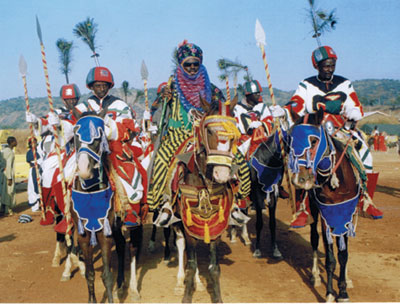
Friday, Oct. 3, 6 pm We're inviting all SL equestrians--and even the horses themselves--to come out for a durbar, where horses and riders are decorated to the teeth and prance around to the wonderment of others. And afterwards? Why, a dance party with African music, of course!

Saturday, Oct. 3, 11 am slt Tamsin will trot out the slides and give a talk about African art and its rules--were they meant to be broken? If you've ever been a little puzzled about why African art looks the way it does, come and rev up your knowledge pronto!

Saturday, Oct. 3 noon slt Oh, today is the decorated canoe regatta! How many will there be? One? Two? Dozens? Get yourself down to Saminaka's infohub tent in advance and pick up a canoe box with free mod canoe, some pennants, and a link to a rl Nigerian regatta, and get to decorating! Tam will give you permission to rez your canoe if you arrive 10 mins or so in advance. And there's a prize....

Saturday, Oct. 3 5 pm slt Masqueraders, acrobats, stiltwalkers galore! Put on your costume and join us, or just gawk! And right after the regatta and masqueraders, it's time for another African dance party--pull out the stops!

Sunday, Oct. 4, 11 am-2pm (this will be off-sim, starting at the University of Delaware's SL Headquarters, but there will be a tp at Saminaka to get you there from the infohub tent). The launch of Ananse, academics interested in Africa and the Diaspora in Virtual Worlds, gets underway with a talk by two content persons AND techies: Britain's Khoisan Fisher introduces Bryan Mnemonic, who will discuss Virtual Harlem and the Virtual Age. Afterwards, guided tours of Virtual Africa, The Middle Passage in Africa and the US, and Virtual Harlem.

Sunday, Oct. 4, 5 pm slt Our very own Oliha Yiwama is a man of many caps and crowns--two involve African divination and spiritual traditions, focusing on Nigeria's Edo and Yoruba people. Listen to this priest and diviner talk about African Spiritual Traditions, his American background uniting with 12 years of Nigerian training!

Sunday, Oct. 4, 6 pm slt Masqueraders, acrobats, and stiltwalkers tripping the light fantastic again, as a prelude to you dancing to terrific DJ'ed African music under the stars. A final fireworks display will herald the announcement of the winners of the photo contests AND--will you be the best-dressed African man or woman? Because each of them will get a prize too! Dress up!

Tuesday, September 22, 2009

This Week in the Compass

This week our regular features are complemented by columns on African music, African masquerade, and African fashion--all in preparation for Saminaka's upcoming festival.

African Masquerade, Second-Life style!!!


African masks hang on museum and collectors' walls, but African
masquerades dance, and masqueraders wear them. There! In one sentence, the kineticism of a masquerade, the terminology, and the combination of object and costume are laid out.

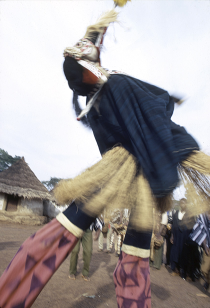
Masquerades in Africa are quite different from masquerade balls in New Orleans or Venice. Their appearance and impetus, as well as the identities of those who wear them, make them distinctive. In the continent, there's only one region (in parts of Sierra Leone/Liberia/Guinea) where women wear masquerades--here you see one at left in wooden mask and dyed black raffia costume. In the rest of Africa, it's men, men, and men.

While many masquerades are for entertainment purposes--a relief from the tedium of everyday life--more are involved with incorporating and impersonating spirits, whether ancestral or entities that inhabit the bush or waterways. Spirits, if you flatter them, can bring you blessings--and masquerades are a perfect way to swell their spirit breasts and make them feel magnanimous. Just because a masquerade has a spiritual dimension doesn't mean it is humorless. When teenage boys dress up as spirit women and insert padding or a stick to enlarge their buttocks, then proceed to burlesque women's walks and dances, hilarity ensues.

Some masquerades, however, are solemn or intentionally frightening. Igbo males spirits, for example, are represented with a fierce conglomeration of human and animal-like features that include tusks, sharp canines, and horns. They carry machetes and other weapons, and would rush the crowd if not restained by their "keepers." Yoruba witch-hunters are decorated with medicines, including small animal skulls, in an effort to warn malefactors that they, too, can kill.

Other masquerades were once human, and relish the chance to again dance with their family members, bestowing blessings on them.

At Saminaka's African festival, there will be periodic, as well as staged, appearances by a variety of African masqueraders. Would you like to be one? IM Tamsin Barzane, and she'll set you up, or check out the masquerade stall on the Festival market ground. See you there!

UNDER THE MANGO TREE--Tamsin Barzane

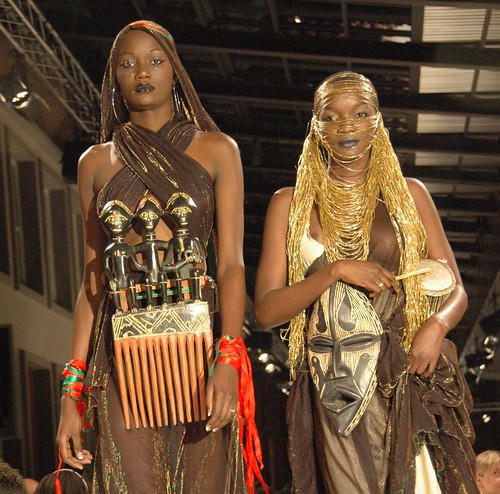
African fashion!!! Yes, the upcoming African Festival on Saminaka (Oct. 1-4) will include a competition, with prizes going to the best dressed male and female in African attire. While Saminaka sells traditional clothing at Cinnamon Brigade (soon to be folded into our cacao megastore), other excellent finds are available elsewhere in SL, and some will be sold at the booths in our festival market. But what about fashion IN Africa?

Basically African fashionista(o)s fall into four categories: those who follow changing textile fashions but who stick to traditional clothing shapes that change little (the wrapper and buba, the agbada or boubou "big gowns" for men, the men's caftan or dashiki or wrapper), those who wear what foreigners think of as traditional dress, but are really 20th century inventions (the long skirt with overblouse that can vary tremendously over time; the pants/top combos from wax prints for men), those who wear the latest foreign labels, and those who are couturiers, taking ideas and fabrics and transforming them into alta moda, international class Fashion with a capital "F."

This last group has members who have created spectacular looks featured in Paris and Milan, and I'd like to introduce you to one of my favorites, both for her outrageous twists and turns on traditional dress and objects, and for her artistry. Her name is Oumou Sy, an elegant woman in her fifties, and she is based in Dakar, Senegal, but has shown her works to international acclaim in Europe and elsewhere.

Ms. Sy has injected humor as well as beauty into her designs, possibly because she comes from theatrical roots--parlaying them into the foundation of the Dakar Carnival, and International Fashion Week in Dakar. She's always on top of things, creating the first cybercafe in Senegal years ago, along with an enchanting website.

Her stores in Geneva and Paris sell to the ultrafashionable, and she designs for World Music superstars like Youssou n'Dour. She's won the enviable couture Prince Claus award, as well as the French government's Legion d'Honneur.

Her designs sometimes inject matting, or small calabash gourds, or other items not usually combined with clothing, including masks and musical instruments.
When she takes an ethnic group as inspiration, her riffs are often awe-inspiring. A silver Tuareg item becomes aggrandized into a breastplate and helmet, or a gold Fulani earring becomes a sleeve.
Sy has not limited herself to the elegant fashions of her home area, but draws on inspiration from the entire continent--whether through materials (a lovely series of feathered gowns), textiles or accessories.

Sy's inventiveness and theatricality remind me of her age-mate Julie Taymore, the director and costumier who shaped Broadway's Lion King, as well as the films Titus, Frida, and the upcoming Spiderman, the Musical. With Sy's involvement in projects in partnership with her filmmaker husband Michel Mavros, such as the exciting Sahel Opera project (which he directs), perhaps her eye will turn in future to projects similar to Taymor's, injecting a new vision into art forms we are more familiar with.
And if her interests keep you more firmly rooted in couture? Then we have much to ahead to, since her own imagination and the visual resources of the continent seem inexhaustible. I guarantee you cacao's haute couture division is likely to feel the Sy excitement and figure out ways to absorb her magical touch with fabric's and fashion.
See some catwalk videos of Oumou Sy's work here: http://www.youtube.com/watch?v=VeiXgcDkVpI
and here:

THIS WEEK IN SAMINAKA--Sept. 22-28, 2009


Tues, Sept. 22 at 6 pm SLT. Weekly meeting of Egbe Akowe Writers Group at the new Slates, Scrolls & Sticks, Saminaka's library cum bookstore. Join the group and receive its missives by hitting the Subscribe-o-Matic (it doesn't add to group count) at the meeting location. http://slurl.com/secondlife/Saminaka/174/194/30 or the Manatee Lookout Palm Wine Joint on Tarkwa Beach.

This week we will each be taking individual directions with the prompt "Africa" Come join us!


Thursday, Sept. 24 at 1 pm slt. European decorate your canoe workshop (American workshop next week)! Saminaka's African Festival is coming up fast, and you'll want to be part of the regatta--and maybe win a prize! The regatta is a Nigerian-style festive event, whereby participants decorate a canoe with canopy, pennants, even revolving platforms! If you're a regular builder, all you need to do is look at a slideshow, and you'll be on your way--but if you don't build much, you need a feel for how it's done. We'll give you a free, modifiable canoe and some full-perm pennants with instructions to get you started!

Tuesday, September 15, 2009

STILTWALKING--Tamsin Barzane


Stilts. What you think of when you hear that word depends on your experiences. Maybe clowns at the circus with extraordinarily long legs, maybe Carnival performers. I think of Liberia. I’ve never been to Liberia, mind, but when I was young, my parents acceded to my birthday wishes and took me to see an African dance troupe performing in Philadelphia. There were dancers aplenty, but the stiltwalkers were taller than anything I’d ever seen on the Ed Sullivan Show (yes, dating myself), and moved with a majestically supernatural grace, their long, mantis-like legs covered with striped fabric.


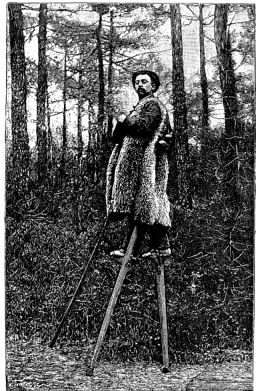
In many regions of the world, stilts developed for work purposes. French shepherds used them to navigate over marshy ground and have an elevated viewpoint for tracking flock members, while drywall installers and painters often employ them to avoid climbing up and down ladders. Even fruit pickers in California sometimes prune trees and collect their bounty with ease of these elevators.

Entertainment has also been a major stilting function. Millennia ago, the Chinese began to use them for imperial performances. European festivals that feature dancing or racing take place in Belgium, Spain and the Netherlands. The Marquesas Islands of the South Pacific used to have races, as well as a form of stilt fighting. The Japanese played with them, calling them takeuma (bamboo horse). Many American street fairs and parades use them as major attractions. Cleveland’s Parade the Circle annual event (second Saturday in June—a fabulous Cleveland Museum of Art festival that is certainly not just for children) trains stiltwalkers, and in the weeks before the main event, teachers and returnees awe those working on their costumes with acrobatics and even soccer games.

This Parade’s stiltwalkers have a geneology direct from Trinidad and Tobago, for its organizer, artist Robin van Lear, has for twenty years brought in international artists with long pedigrees in the island nations’ Carnival tradition. And this tradition is one that features moko jumbies, costumed stiltwalkers who have been a part of Carnival for two centuries or more. They were not restrained to Trinidad; in St. Vincent of the Virgin Islands, a “mocko jumbo” on stilts was recorded in 1791, an animal head covering the performer’s own.

Trinidadian (and Tobago!) users are not precise about which part of Africa the moko jumbie came from, vaguely citing Kongo and Nupe sources—two unrelated ethnic groups vastly distant from one another, neither of which uses stilts today. Numerous West African groups are stilt users, however, including

Nigeria’s Urhobo, Gabon’s Punu, the Ivory Coast/Liberia’s Dan, Mali's Dogon, groups in the Senegambia, Mali, Guinea, Ghana and elsewhere.

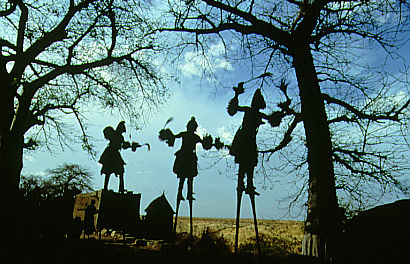
The African stilts are often 12 feet high, and always worn by men. They are frequently masqueraders, faces covered. In some areas they are considered messengers to the ancestors or spiritual guardians. In others, they are dancers only, albeit mysterious ones whose abilities, by consensus, are attributed to powerful supernatural medicines. When performances take place at night, their looming presence can be positively frightening—they lope along, casting odd moonshadows, as drummers beat for them.

For Saminaka’s upcoming African Festival, Oct. 1-4, 2009, stiltwalkers from several traditions will stride across the landscape, reminding observers of a powerful tradition that crossed the Atlantic, and continues to spread. Would you like to join us as a participant, rather than just an observer? Contact Tamsin Barzane inworld, or here on the blog!

To see a West African stiltdancer from the Dan people, see: http://www.youtube.com/watch?v=I7H9f0paCCo

To see “Mokolution”, a multi-part documentary from the American Virgin Islands about the tradition in both Africa and the Americas, see: http://www.youtube.com/watch?v=nOU1TyYd_3U&feature=PlayList&p=516556F1AAEB4CE8&playnext=1&playnext_from=PL&index=1

Monday, September 7, 2009

UPCOMING AFRICAN FESTIVAL--DURBAR!!!!


Don't forget to mark your calendar!!! Saminaka will host SL's first-ever African Festival, and we want to make it a memorable one! In addition to some new architecture, there will be lectures, contests, a decorated canoe regatta (see last week's issue), parties with African music, demonstrations, masqueraders, stiltwalkers and acrobats, a treasure hunt, several exhibitions, readings, and...a durbar!

What? You didn't all react with astonishment and joy? Did I sense some of you scratching your heads and mouthing, "What's a durbar?" What indeed? The durbar is one of those rare breeds--something introduced by colonialists that everybody enjoys! The British took the concept of Indian displays of horsemanship, the product of Mogul courts, whispered about it to the Hausa emirs, and presto! A new form of royal entertainment was born.

"Durbar" is actually a Persian word, used to mean either a state council meeting in India or, under the British, a ceremonial review. The first was a demonstration of loyalty to the Crown held in 1877 when Victoria was first called "Empress of India," but they were regular features of the British Raj.

While the purpose in Nigeria may have been similar in colonial days, durbars persist in numerous Northern Nigerian emirates, a way for rulers to dazzle their constituents and bask in the approval and admiration of their citizens. These celebrations consist of a parade on horseback by the king, his chiefs, and selected officials, accompanied by music. They are a considerable draw for tourists as well as the


community, and are scheduled during sallah (religious celebration) periods, primarily at Eid-el-Fitr and Eid-el-Kabir.

While durbars are mostly Hausa festivals (held regularly at Kano, Zaria, Bauchi, and Katsina), the Nupe also hold them at Bida. They are most definitely events at which one sees and is seen, and they evoke the historical past when savannah armies on horseback crossed large territories, officers in splendid embroidered robes and turbans. The horses themselves are on show as well, wearing leather and metallic trappings like the finest of jewels.

Saminaka's durbar may include some citizens on horseback, but it will certainly include horse avatars enjoying the admiration of onlookers. In the week or so prior to the festival, Northern Nigerian leatherworkers will enter the sim to put their products in the market for the interested equine community. The festival itself will include a colorful slide display and examination of the horse's place in African history, as well as a book that includes the identical information. Come saddle up with us!

Tuesday, September 1, 2009

Nigerian Regattas and Saminaka's African Festival!!!


Saminaka’s September is going to be rife with preparations, for October 1 is Nigerian National Day! And as we are a Virtual Nigeria, it’s celebration time! We’re planning all kinds of exciting activities for our upcoming first annual African Festival!!! In the upcoming weeks the Compass will feature stories about some of our featured activities, which begin the evening of Oct. 1 and conclude Oct. 4.


What do you think of when you hear the word “regatta”? Yachts with sails ballooning? Power boats full of laughing passengers, chugging in a line up the river? Well, abandon all those thoughts and paint yourself a new regatta! Nigeria’s riverine peoples have a tradition of decorating their canoes for exciting displays of color, dance and rhythmic paddle slapping.


West African canoes are dugouts, made from single hollowed tree trunks. In many countries—Ghana, Ivory Coast, Cameroon, Benin Republic, Togo—they are painted or otherwise ornamented with carved segments. Beach visitors are struck by their picturesque qualities, and Flickr is full of tourist shots of these attractive boats--but a flotilla of canoes with even more elaborate embellishments seems to be exclusively Nigerian.


Regatta at Nigeria's Argungu fishing festivalWhile many canoes are small, meant for individual transport and fishing, the dugouts used for regattas are usually larger. In the days before other transport, huge canoes were used for long-distance trade or war parties. They could hold up to 30 people, or be loaded with foodstuffs, cloth and other goods. Regattas developed as a social version of the cavalcades of soldiers and merchants, with paddlers dressed alike, their canoes decorated with awnings, pennants, and dancers on attached platforms.


Stanley noted a display of war canoes in 19th century Uganda: "The largest canoe seen by me in this fleet measured 72 feet in length, 7 feet three inches in breadth...There were probably over a hundred canoes between 50 and 70 feet in length, and about 50 between 30 and 50 feet long...The largest class--100 in number--would require on an average fifty men each to man them." The various Nigerian fleets were comparable


The Ijo, Itsekiri, riverine Yoruba and Nupe take part in regattas for special occasions—distinguished visitors, holidays, coronation anniversaries and more. They have a competitive element, each vying to inject more eye-catching displays that the next, with prizes awarded to the winners. The sight of a graceful canoe riding low in the water, paddlers slapping a percussive salvo on the waves in perfect unison, would be glorious enough, but some are rigged with revolving elevated sections, women dancing aloft for visibility. At other times, a dancer will take to the prow, vigorously performing in a precarious location. Dance in riverine areas is extremely graceful, inspired by the balance developed by canoe use. It often employs a position bent at the waist, and when performed in a canoe requires a delicate set of calculations to ensure neither the canoe nor the dancer are overset.


Regattas and festivals are a natural fit, so we want to have one for our African Festival! Through the kindness of Carricre Wind, we have a supply of modifiable simple dugouts. It is up to you, dear readers, to transform them from serviceable crafts to things of beauty, to staff them with similarly dressed friends and dancers or man them alone. Paint them, deck them with fluttering cloths, do what you will. They are available in a box at Saminaka’s infohub throughout September, so ready yourself! When the Festival event times are finalized, come and participate or watch, and be in the running for some splendid prizes!


Get a look at the real thing with this short video from the Ijo city-state of Nembe: http://www.youtube.com/watch?v=ASWikKDouIQ


And pick up your canoe, ready for growth, painting and decoration at: http://slurl.com/secondlife/Saminaka/57/157/22

Hawking in the Market

Nsukka, Nigeria, Nigeria Shopping, photo, picture, image

***Last week Tamsin had no Internet, which meant a delay in everything--the publication of the Compass, the erection of the new shrine, the revamping of Adire into a fully orisha products store, etc. But it's back! So look for changes by the weekend!


***Oliha has returned from Nigeria, raring to go! His office on Saminaka will be accessible directly from the beachside, beside the new shrine, or through the Adire store. Be on the lookout!


***VENDORS! See the ad above for news of temporary stalls for your African goods on Saminaka during the African Festival, Oct. 1-4.