Showing posts with label Africa in Second Life. Show all posts

Tuesday, October 20, 2009

***ADVERTISEMENT***

****Advertisement****


AFRICAN MYSTICAL SCIENCES ON SAMINAKA! SULTAN OLIHA YIWAMA
(HIGH PRIEST OF AFRICAN MYSTICAL SCIENCES)
EXPERIENCE THE ANCIENT SECRETS OF AFRICA!!! Divination/Consultations
African Medicine
African Naming
Ceremonies
African Weddings
Initiations
Shrine Work
Compelling Magic
Unjinxing
Orisha store!

IM Oliha Yiwama for a consultation. Reasonable rates.

Wednesday, October 14, 2009

****Advertisement****


Solylence combines Senegalese elegance and Parisian chic in her lovely African attire for men and women.
Visit it at: http://slurl.com/secondlife/Robben%20Island/123/191/21

UNDER THE MANGO TREE--Tamsin Barzane


When Saminaka was born in 2008, I built (with the help and advice of the kind and skilled Readly Oh) a small Nupe compound. It was my first foray into the construction business, and I had Readly show me how to create a round house with a Nupe style door and window opening. Then I was ready for bigger fish! I made an old-style Nupe palace katamba, the grand round entrance building with support posts. By rights, it should have had opposing tall doorways for the entrance and egress of chiefs on horseback, but I was already struggling with megaprims, Tokoroten and sculpted posts, and a temp rezzer that would allow me to pack 50 plus prims into one box.


The Nupekwo compound had three or four houses that stood empty for a while, but the delightful Cymindra moved in, and since then the tenancy has changed very little. Recently several others have chosen to move it, so I added a few buildings. I like my six tenants tremendously, and am proud they've chosen to like in Saminaka, even though they don't actually spend much time in their cramped quarters.
Contemplating them made me think of the nature of "home" in Second Life, and our curious human impulses. I have an SL home, and acquired the land within a month or two of signing up. I fell in love with the terrain, and the fact it was part of a five-sim package, much of it open water. I knew my two neighbors, and made two other local friends.


The plot is an odd shape--very difficult for most houses. I kept trying to squeeze and rotate, never thinking of asking the estate manager to manipulate the shoreline! My first domicile was much to big to decorate within the prim limits, so it always looked empty. I was about to buy one of Barnesworth Annubis' Moroccan homes just when my friend Chan tired of hers, so she dropped it onto my land. It was perfect--until I messed up its open/close Moorish windows and somehow locked all the doors--and because it wasn't mine, not much I could do! But I managed it.

I recently decided to try to build more, and am trying out a modified structure from Mali as my house. It's unfinished, and still unfurnished--a measure of how little I use this "home." Yet I don't want to get rid of it, even though there's less open water, and no longer an unimpeded view. Why? I'm not slexing it up between the sheets, or throwing fabulous parties. It IS nice not to change clothes at the bottom of the ocean, but that's not it either.

And I've been tempted. I bought it before land became virtually free except for the tier, and know I'd never get its costs back. Still, it is a kind of base, and I've grown affectionate towards it. It's "my place" and it's in an idyllic environment. And as I turn the heat on for the season and look out at the unpulled weeds on a vacant lot, or a building that needs to be pulled down, the idyllic home holds a beacon of warmth and welcome.

So maybe that's what the tenants feel, too. I pledge to create fun activities and make their environment full of beauty, because I feel pleasure when I see their little lights on the mini-map. I want them to know that Saminaka will remain interesting, refreshing and stimulating, while winters may roar around them, or their own living room turn into a maelstorm. Welcome home!

FROM THE SUITCASE--Oliha Yiwama

Jammin' with Spirit


Wow! Saminaka had a great African festival last week--masquerades, music, drums, dance, cultural attire and talks. We had a record participation from our guests as well. I want to congratulate the new members of the African Mystics for embarking on their spiritual journey. Last but certainly not least, I'd like to congratulate and thank Tamsin for allowing all of this to take place. Go Tamsin! I gave a talk on African music and spirituality during the festival and launched the African Mystics group. The wonders and complexity of Nigeria are evident. Each one of the above activities has a major role in African mysticism.


In African mysticism, especially in Nigeria, inter-connectivity between various components of personal and communal expression is quite common. Some of the masquerade performers in the festival represented ancestral spirits and concepts that involve music, dance, and symbolic representation of moral codes. Others involved music, dance, and festivities.


The music and dance take the visual and audible realms to such an ecstatic level that the spiritual realm merges with the physical. As the masquerades danced and moved about Saminaka to the tunes of African music--traditional to modern--the energy vibes rose and corresponded with the vibrational level of participation of our guests. In short, it took us to a realm that was a mix of physical excitement and spiritual joy.


After the talk on African music, there was an impromptu drum jam. There were several drummers, and dancers took part as well. Many were dressed in African attire, but all were jamming to the sounds of Africa. We had djembe, xylophone, conga, horns, and other drums that played the beats specific to those instruments. The dancers floated freely on the dance floor, adding to the ephemeral experience. The dancers attenuated the drum beats, wiggling and jiggling to the melodic polyrhythms. The rhythms were often hypnotic, placing the drummer and dancer in a euphoric state and bond. There was no standing around or just watching the other avatars there--that kind of experience requires direct participation.


Later that night, DJs took over the course of the music. The DJs that spinned the jams at the festival were awesome! They played a mix of music that also brought out the spirit that resides in us. The dance area was full; the music, as well as the vibes, lifted everyone’s spirit. All the avatars looked like kings and queens in their traditional African attire. But it was also more than the attire that brought out the beauty. It was the spirit from the festival experience. The spirit evolved from the combination of drum, dance, masquerade, music and cultural attire. A communal spiritual participation. The spirit moves us to commune with the divine when all the ingredients are there!

Tuesday, October 13, 2009

****Advertisement****


AFRICAN MYSTICAL SCIENCES ON SAMINAKA! SULTAN OLIHA YIWAMA
(HIGH PRIEST OF AFRICAN MYSTICAL SCIENCES)
EXPERIENCE THE ANCIENT SECRETS OF AFRICA!!! Divination/Consultations
African Medicine
African Naming
Ceremonies
African Weddings
Initiations
Shrine Work
Compelling Magic
Unjinxing
Orisha store!

IM Oliha Yiwama for a consultation. Reasonable rates.

Tuesday, October 6, 2009

African music in Second Life--Tamsin Barzane

The recently concluded African Festival on Second Life had many musical moments, thought that was never intended to be its focus. But it proved a maxim, one that Oliha Yiwama mentioned in his talks on both drumming and spiritual traditions--music and dance bring people together, celebration is prayer, the spirit can unite people and make their spirits soar! (well, all right, he said it more eloquently).

We wanted live music and nearly had it in two doses. The very kind Bourque Rau promotes Second Life live music, and did her best to hunt down performers who worked either in African style or something close. She connected me with the very talented Peregrine Singh, who mulled over the possibilities of bringing in musician friends from Gambia and Guinea, and I began to salivate. Real life prevented it, but who knows in future? And if not for sound problems, we would have had master rl drummer Oliha Yiwama bringing us West African rhythms in several traditions, which we trust will still happen in times ahead.

We had three fabulous DJs play African music: HarleyMC Homewood, Blade Unsustainable and Isabelle Mavendorf (Soulman Sands is another tested and true, but unavailable during the festival). Their tastes were all different, and all fabulous--we had Afrobeatphilacs, African house music miners, and plaintive balladeers. Miles Barbasz was feverishly writing down artists' names, and he'd better hand over his list!

We filled the sim (it's a homestead, but I'm convinced it would have been filled even in a full prim)! People tried and tried and finally tped in, that's how good the sound reports were. And they chatted as the fireworks went off and the hips shook--not senseless spamastic gestures, but conversations and spontaneous eruptions of joy. Friendships were forged, and our last night's Best Dressed in African Attire saw a bevy of beauties of both sexes (winners--Blac Quartz and Pietro Eberhardt), dancing under the stars.
One of the best musical events was totally unplanned. I sat in a vendor's stall with Feretian String, just chatting. Oronoque Westland wandered by, and asked if her playing a flute would be annoying. Certainly not! Soon her haunting South American tunes were joined by my Yoruba talking drum and Fere on a standing one--then Oron switched to electric sitar, then guitar and steel pan. We had a jam session that lasted for close to two hours, joined by Solylence Houston, Szvanna Anatra, the others who danced and played. For a while we were the all female Princesses of Percussion (POP)--Fere to thank for that sporty moniker--then were joined by others of the male persuasion.

At times we actually seemed in sync, and a thrill swept over us! I hope scripters make more musical instruments and work in some timing controls, because, as Oliha Yiwama pointed out, this is a great opportunity for those who never had exposure or practice--or skill--to make beautiful music. But we're more than happy to make a joyful noise here!

Tuesday, September 29, 2009

FROM THE SUITCASE--Oliha Yiwama


“Come to me, my love...”


African medicine is a really in-depth practice that includes not only the physical, but the spiritual, psychological, emotional, and mental aspects of the individual and community. Each aspect also includes use of herbal and ritual methods of medicine. I have touched upon traditional African medicine in earlier columns, but the realm of African medicine is vast.


One of the categories of traditional African medicine I like to approach is Compelling Medicine. In general, in traditional African thought, a native doctor, through understanding the physical application of medicines, believes that a person can be controlled, or compelled to perform or restrained from doing a number of activities. Probably the most famous of the compelling medicines are the ones that will make a lover or potential lover fall head-over-heels with the person using the medicine. Those that draw money are equally popular.


Africans have been using advanced forms of science for many generations, before Western medicines attained similar concepts. For instance, in many love medicines or potions, some part of the potential lover's DNA material is required, whether bodily fluids, hair, or a piece of one of their garments. Although not used for love medicines, Western science now recognizes the concept and value of DNA's unique combination in one particular person, and its ability to identify that person.


Well, Africans were aware of that general scientific concept for centuries! Personal DNA, mixed with herbal, mineral and animal ingredients, usually along with an incantation used to spark or enhance the potency is the method employed to attract love and money.


Probably the most famous place where compelling medicines have made their mark is in Nigeria. Ads by native doctors who possess compelling medicine are frequent, and the clients who use compelling medicine are more frequent than the ads.


Although Nigeria may be well known for its compelling medicines, love and money are the preoccupation of the world. People go to soothsayers, seers, prophets, priests, clergy, and their mothers to find ways to bring love and money--which are often related!


Love and money-compelling medicines also made their way to the Americas via West Africans. Here they go by a variety of names: gris-gris, hand, mojo hand, jomo, root bag, luck hand, conjure bag, toby, savon patchuoli soap, money drawing candles, etc. For the love of money!


Compelling medicines have been tried and tested for centuries, and still find their place during this modern era. Well, you be the judge. Love and money drawing medicines will soon be sold at the Iyawo store on Saminaka. See ya there!

Tuesday, September 22, 2009

This Week in the Compass

This week our regular features are complemented by columns on African music, African masquerade, and African fashion--all in preparation for Saminaka's upcoming festival.

******Advertisement********


AFRICAN MYSTICAL SCIENCES ON SAMINAKA!

SULTAN OLIHA YIWAMA (HIGH PRIEST OF AFRICAN MYSTICAL SCIENCES)

EXPERIENCE THE ANCIENT SECRETS OF AFRICA!!!

Divination/Consultations
African Medicine
African Naming Ceremonies
African Weddings
Initiations
Shrine Work
Compelling Magic
Unjinxing

Orisha store coming soon!

IM Oliha Yiwama for a consultation. Reasonable rates.

Tuesday, September 15, 2009

STILTWALKING--Tamsin Barzane


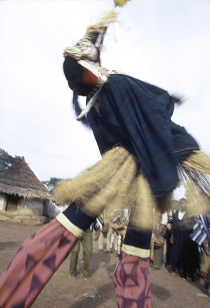
Stilts. What you think of when you hear that word depends on your experiences. Maybe clowns at the circus with extraordinarily long legs, maybe Carnival performers. I think of Liberia. I’ve never been to Liberia, mind, but when I was young, my parents acceded to my birthday wishes and took me to see an African dance troupe performing in Philadelphia. There were dancers aplenty, but the stiltwalkers were taller than anything I’d ever seen on the Ed Sullivan Show (yes, dating myself), and moved with a majestically supernatural grace, their long, mantis-like legs covered with striped fabric.


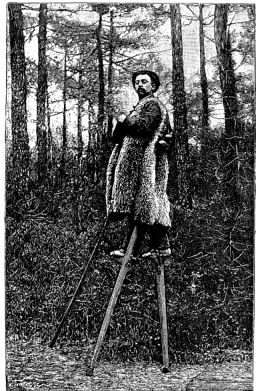
In many regions of the world, stilts developed for work purposes. French shepherds used them to navigate over marshy ground and have an elevated viewpoint for tracking flock members, while drywall installers and painters often employ them to avoid climbing up and down ladders. Even fruit pickers in California sometimes prune trees and collect their bounty with ease of these elevators.

Entertainment has also been a major stilting function. Millennia ago, the Chinese began to use them for imperial performances. European festivals that feature dancing or racing take place in Belgium, Spain and the Netherlands. The Marquesas Islands of the South Pacific used to have races, as well as a form of stilt fighting. The Japanese played with them, calling them takeuma (bamboo horse). Many American street fairs and parades use them as major attractions. Cleveland’s Parade the Circle annual event (second Saturday in June—a fabulous Cleveland Museum of Art festival that is certainly not just for children) trains stiltwalkers, and in the weeks before the main event, teachers and returnees awe those working on their costumes with acrobatics and even soccer games.

This Parade’s stiltwalkers have a geneology direct from Trinidad and Tobago, for its organizer, artist Robin van Lear, has for twenty years brought in international artists with long pedigrees in the island nations’ Carnival tradition. And this tradition is one that features moko jumbies, costumed stiltwalkers who have been a part of Carnival for two centuries or more. They were not restrained to Trinidad; in St. Vincent of the Virgin Islands, a “mocko jumbo” on stilts was recorded in 1791, an animal head covering the performer’s own.

Trinidadian (and Tobago!) users are not precise about which part of Africa the moko jumbie came from, vaguely citing Kongo and Nupe sources—two unrelated ethnic groups vastly distant from one another, neither of which uses stilts today. Numerous West African groups are stilt users, however, including

Nigeria’s Urhobo, Gabon’s Punu, the Ivory Coast/Liberia’s Dan, Mali's Dogon, groups in the Senegambia, Mali, Guinea, Ghana and elsewhere.

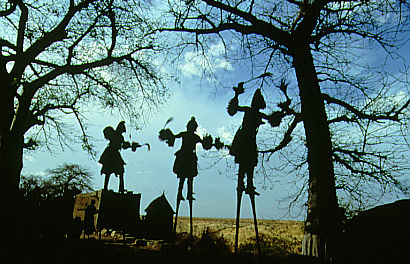
The African stilts are often 12 feet high, and always worn by men. They are frequently masqueraders, faces covered. In some areas they are considered messengers to the ancestors or spiritual guardians. In others, they are dancers only, albeit mysterious ones whose abilities, by consensus, are attributed to powerful supernatural medicines. When performances take place at night, their looming presence can be positively frightening—they lope along, casting odd moonshadows, as drummers beat for them.

For Saminaka’s upcoming African Festival, Oct. 1-4, 2009, stiltwalkers from several traditions will stride across the landscape, reminding observers of a powerful tradition that crossed the Atlantic, and continues to spread. Would you like to join us as a participant, rather than just an observer? Contact Tamsin Barzane inworld, or here on the blog!

To see a West African stiltdancer from the Dan people, see: http://www.youtube.com/watch?v=I7H9f0paCCo

To see “Mokolution”, a multi-part documentary from the American Virgin Islands about the tradition in both Africa and the Americas, see: http://www.youtube.com/watch?v=nOU1TyYd_3U&feature=PlayList&p=516556F1AAEB4CE8&playnext=1&playnext_from=PL&index=1
***Advertisement***


AFRICAN MYSTICAL SCIENCES ON SAMINAKA!

SULTAN OLIHA YIWAMA (HIGH PRIEST OF AFRICAN MYSTICAL SCIENCES)

EXPERIENCE THE ANCIENT SECRETS OF AFRICA!!!

Divination/Consultations
African Medicine
African Naming Ceremonies
African Weddings
Initiations
Shrine Work
Compelling Magic
Unjinxing

Orisha store coming soon!

IM Oliha Yiwama for a consultation. Reasonable rates.