Tuesday, November 3, 2009
From the Suitcase--Oliha Yiwama

***ADVERTISEMENT***
AFRICAN MYSTICAL SCIENCES ON SAMINAKA! SULTAN OLIHA YIWAMA
(HIGH PRIEST OF AFRICAN MYSTICAL SCIENCES)
EXPERIENCE THE ANCIENT SECRETS OF AFRICA!!! Divination/Consultations
African Medicine
African Naming
Ceremonies
African Weddings
Initiations
Shrine Work
Compelling Magic
Unjinxing
Orisha store!
IM Oliha Yiwama for a consultation. Reasonable rates
Tuesday, October 20, 2009
From the Suitcase--Oliha Yiwama

What’s the Word
Alafia!!! Alafia means peace in the Yoruba language. Alafia is also a greeting. Similar to a|
namaste in Hindu, or a shalom in Hebrew, or a assalam alikum in Arabic, etc. Although these greetings are from many different ethnic groups from around the world, they all convey a single meaning, a word of power: Peace! In traditional African societies, words of power are used most efficiently by native doctors or what the West refers to as shamans.
What is a word of power? Words of power help one convey, imagine, manifest, control or manipulate transformative energy. Words of power can turn the unseen into the seen, the obscure into the secure, the imaginary into the real. Words of power sometimes can be a part of everyday language, such as the words conveying peace, reassuring hearers that all is well, envisioning a dove with a fig branch in its mouth and all the soothing symbolism that goes along with the concept. Words of power can also be restricted to mystical ritual practitioners that through the millennia discovered the secrets of transformative energies.
Some words of power that are used to make things manifest from a ritualistic view are ashe/ase of the Yoruba, ise of the Edo, and om of the Hindu. Roughly, the meaning is let these things that I ask for come true or may it manifest. Mystical practitioners take the use of words of power further than the layman. A mystical practitioner uses the words of power to make his/her desires manifest as well as those of their clients and community. From transforming the ingredients in a herbal potion to cure a disease, to transforming the human body into a four-legged animal, or flying to an undisclosed destination. Transformation is what the alchemist searches for--but the African mystic knows where to find it.
The African mystic uses incantations as one of the methods of transforming substances. Incantations consist of words of power. A good example is the phrase Yoruba word Eji Ogbe. Eji Ogbe is an Ifa Odu. An Odu is a word of power that conveys messages through the Ifa oracle. Eji Ogbe symbolizes spiritual awakening, peace and prosperity, victory over enemies, and long life. Once Eji Ogbe comes out in divination, the mystical ritual practitioner can utter these words to make this word of power manifest for the client or himself.
Words of power are also used to control nature, such as water, wind, fire, and earth. According to the world's oral literature, the creator uttered a word of power and everything came into existence. May you use a word of power to transform the world!
Tuesday, September 29, 2009
****Advertisement****
AFRICAN MYSTICAL SCIENCES ON SAMINAKA!
SULTAN OLIHA YIWAMA (HIGH PRIEST OF AFRICAN MYSTICAL SCIENCES)EXPERIENCE THE ANCIENT SECRETS OF AFRICA!!!
Divination/Consultations
African Medicine
African Naming Ceremonies
African Weddings
Initiations
Shrine Work
Compelling Magic
Unjinxing
Orisha store coming soon!
IM Oliha Yiwama for a consultation. Reasonable rates.
Tuesday, September 22, 2009
******Advertisement********
AFRICAN MYSTICAL SCIENCES ON SAMINAKA!
SULTAN OLIHA YIWAMA (HIGH PRIEST OF AFRICAN MYSTICAL SCIENCES)EXPERIENCE THE ANCIENT SECRETS OF AFRICA!!!
Divination/Consultations
African Medicine
African Naming Ceremonies
African Weddings
Initiations
Shrine Work
Compelling Magic
Unjinxing
Orisha store coming soon!
IM Oliha Yiwama for a consultation. Reasonable rates.
Tuesday, September 15, 2009
FROM THE SUITCASE--Oliha Yiwama

Remembering Our Loved Ones
Africa is composed of many ethnic groups, cultures, languages and religions. Some of my friends have focused on the diversity of Africa, but although Africa is diverse, I have always touted the uniformity of many of African beliefs. One of the most important belief in Africa is ancestral veneration. Africans universally have a great respect for ancestors. Ancestor veneration is at the core of African culture.
In Nigeria, many of the names that refer to ancestors are also used simultaneously with elders. For instance, the Edo people use the word edion to both mean ancestors or elders that are up in age, since they are the repository of ancient wisdom. Many of the moral codes in pre-colonial Nigeria were based upon ancestor veneration, respect for ancestral authority.
According to tradition, food or drinks were poured on the ground in memory of the ancestors. Prayers were directed to the them for help in daily activities or major decisions that affected the family. Ancestral altars are placed in sacred spaces within the home to constantly remind the living of the memory and close ties of the departed.
Yes, the ancestor remains a valuable part of the family, and was constantly consulted. In traditional African societies, the belief that life did not end once a person left the physical realm was paramount. Life continued in the same manner in the spiritual existence, with constant contact between the two spheres. By keeping the ancestors near, moral codes were enforced and family ties were maintained.

The Yoruba are another well-documented group that maintain ancestral veneration. One of the features the Yoruba are best known for is their ancestral masquerade (egungun). The masquerade reinforces the moral codes of that community, and reaffirms the ties between the departed and the remaining souls. In Nigeria, many masquerades represent elaborate stories that reflect moral codes and guidance.
In a sense, the bond between child and parent is never broken in an African society, even after death. In Africa, death was viewed as a transition in a continued cycle of birth and rebirth. In the diaspora, where traditional African customs are maintained in Candomble and Santeria, ancestral veneration also plays a major role. Diaspora shrines have pictures of the departed, as well as ancestral staffs, for remembering the blessings of the departed parents.
The memories that go along with the physical altars are many. For me, it would be unthinkable to not have a place to pay respect and to fondly remember my departed love ones. There are many lessons in life that I can hear spiritually from my granma and granpa. I can remember how it was a healing effect to have finally put the last touches on my ancestral shrine. It is our ancestors and elders that gave us the starting blocks in which to prepare our lives.
In the diaspora, a method of divination that any person can partake in is ancestral divination. The ancestors are the closest bond to our genetic being. It is from their DNA code that we come into existence. It is that code that bonds us to the future generations. One continuous bond.! Those memories feel us with joy and warmth because our sacred ancestors were the first in our genetic line, our caregivers, and confidants.
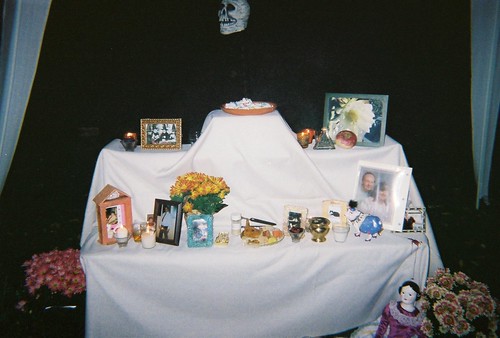
If you are missing one of your parents, maybe an ancestral shrine is in order to re-establish that healing bond. Come see me.
And come to Saminaka's African Festival Oct. 1-4 and experience the wonderful world of African masquerade! The egungun will be there, as well as other masqueraders, ancestral and otherwise.
Monday, September 7, 2009
***ADVERTISEMENT***
AFRICAN MYSTICAL SCIENCES ON SAMINAKA!
SULTAN OLIHA YIWAMA
(HIGH PRIEST OF AFRICAN MYSTICAL SCIENCES)
EXPERIENCE THE ANCIENT SECRETS OF AFRICA!!!
Divination/Consultations
African Medicine
African Naming Ceremonies
African Weddings
Initiations
Shrine Work
Compelling Magic
Unjinxing
Orisha store coming soon!
IM Oliha Yiwama for a consultation. Reasonable rates.
Tuesday, September 1, 2009
From the Suitcase--Oliha Yiwama
 SAMINAKA'S SPIRIT
Traditional African spirituality or religion involves the acknowledgement of all the realms of creation into everyday life. The first and foremost force of creation is God Almighty. God Almighty is known by many names and appellations by the different ethnic groups of Africa. In Nigeria, He is called Olodumare by the Ife Yoruba, Osanobua by Benin's Edo, Chukwu by the Igbo, etc.
Whatever name is applied, God Almighty is recognized as the Supreme Being. Beneath God Almighty is a recognition of the forces that compose creation, both negative and positive. For instance, in traditionl African Medicine, the native doctors acknowledge that medicine has a dual role. It can be used to heal as well as to harm.
Traditional African Medicine also acknowledges the many realms of creation, and possibilities that may affect the client. It is the total person who is healed; the spiritual, mystical, psychological, emotional and physical parts are brought into alignment with divine will.
The total environment of the African plays a major role in the treatment of illness. The role of tropical plants as natural remedies to life’s many obstacles is fundamental to African spirituality. In tradition, the African believes that the cure to all his aliments lays close to his abode.
Saminaka’s lush plant life contains the cures to virtual humankind's many perplexities. Its many healing waters also provide cures for barrenness, poverty, loneliness and miscarriages. Bathe in the waters of Olokun, Osun and Yemanya. Experience the herbal cures from the lush gardens of Saminaka. I invite you to come and enjoy our sim's healing environment, a place of refuge and deep insight into the wonders of creation and the mysteries of life!


 Posts
Posts


