Showing posts with label africa in virtual worlds. Show all posts

Wednesday, October 14, 2009

UNDER THE MANGO TREE--Tamsin Barzane


When Saminaka was born in 2008, I built (with the help and advice of the kind and skilled Readly Oh) a small Nupe compound. It was my first foray into the construction business, and I had Readly show me how to create a round house with a Nupe style door and window opening. Then I was ready for bigger fish! I made an old-style Nupe palace katamba, the grand round entrance building with support posts. By rights, it should have had opposing tall doorways for the entrance and egress of chiefs on horseback, but I was already struggling with megaprims, Tokoroten and sculpted posts, and a temp rezzer that would allow me to pack 50 plus prims into one box.


The Nupekwo compound had three or four houses that stood empty for a while, but the delightful Cymindra moved in, and since then the tenancy has changed very little. Recently several others have chosen to move it, so I added a few buildings. I like my six tenants tremendously, and am proud they've chosen to like in Saminaka, even though they don't actually spend much time in their cramped quarters.
Contemplating them made me think of the nature of "home" in Second Life, and our curious human impulses. I have an SL home, and acquired the land within a month or two of signing up. I fell in love with the terrain, and the fact it was part of a five-sim package, much of it open water. I knew my two neighbors, and made two other local friends.


The plot is an odd shape--very difficult for most houses. I kept trying to squeeze and rotate, never thinking of asking the estate manager to manipulate the shoreline! My first domicile was much to big to decorate within the prim limits, so it always looked empty. I was about to buy one of Barnesworth Annubis' Moroccan homes just when my friend Chan tired of hers, so she dropped it onto my land. It was perfect--until I messed up its open/close Moorish windows and somehow locked all the doors--and because it wasn't mine, not much I could do! But I managed it.

I recently decided to try to build more, and am trying out a modified structure from Mali as my house. It's unfinished, and still unfurnished--a measure of how little I use this "home." Yet I don't want to get rid of it, even though there's less open water, and no longer an unimpeded view. Why? I'm not slexing it up between the sheets, or throwing fabulous parties. It IS nice not to change clothes at the bottom of the ocean, but that's not it either.

And I've been tempted. I bought it before land became virtually free except for the tier, and know I'd never get its costs back. Still, it is a kind of base, and I've grown affectionate towards it. It's "my place" and it's in an idyllic environment. And as I turn the heat on for the season and look out at the unpulled weeds on a vacant lot, or a building that needs to be pulled down, the idyllic home holds a beacon of warmth and welcome.

So maybe that's what the tenants feel, too. I pledge to create fun activities and make their environment full of beauty, because I feel pleasure when I see their little lights on the mini-map. I want them to know that Saminaka will remain interesting, refreshing and stimulating, while winters may roar around them, or their own living room turn into a maelstorm. Welcome home!

Tuesday, October 13, 2009

****Advertisement****


AFRICAN MYSTICAL SCIENCES ON SAMINAKA! SULTAN OLIHA YIWAMA
(HIGH PRIEST OF AFRICAN MYSTICAL SCIENCES)
EXPERIENCE THE ANCIENT SECRETS OF AFRICA!!! Divination/Consultations
African Medicine
African Naming
Ceremonies
African Weddings
Initiations
Shrine Work
Compelling Magic
Unjinxing
Orisha store!

IM Oliha Yiwama for a consultation. Reasonable rates.

Tuesday, September 22, 2009

******Advertisement********


AFRICAN MYSTICAL SCIENCES ON SAMINAKA!

SULTAN OLIHA YIWAMA (HIGH PRIEST OF AFRICAN MYSTICAL SCIENCES)

EXPERIENCE THE ANCIENT SECRETS OF AFRICA!!!

Divination/Consultations
African Medicine
African Naming Ceremonies
African Weddings
Initiations
Shrine Work
Compelling Magic
Unjinxing

Orisha store coming soon!

IM Oliha Yiwama for a consultation. Reasonable rates.

Tuesday, September 15, 2009

FROM THE SUITCASE--Oliha Yiwama


Remembering Our Loved Ones


Africa is composed of many ethnic groups, cultures, languages and religions. Some of my friends have focused on the diversity of Africa, but although Africa is diverse, I have always touted the uniformity of many of African beliefs. One of the most important belief in Africa is ancestral veneration. Africans universally have a great respect for ancestors. Ancestor veneration is at the core of African culture.


In Nigeria, many of the names that refer to ancestors are also used simultaneously with elders. For instance, the Edo people use the word edion to both mean ancestors or elders that are up in age, since they are the repository of ancient wisdom. Many of the moral codes in pre-colonial Nigeria were based upon ancestor veneration, respect for ancestral authority.


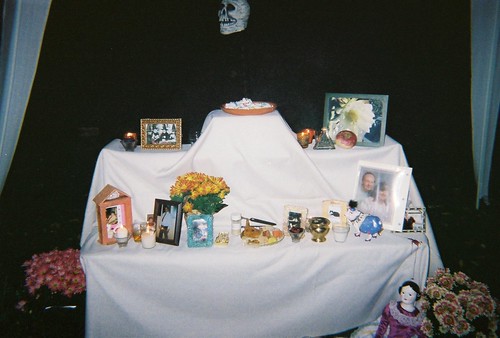
According to tradition, food or drinks were poured on the ground in memory of the ancestors. Prayers were directed to the them for help in daily activities or major decisions that affected the family. Ancestral altars are placed in sacred spaces within the home to constantly remind the living of the memory and close ties of the departed.


Yes, the ancestor remains a valuable part of the family, and was constantly consulted. In traditional African societies, the belief that life did not end once a person left the physical realm was paramount. Life continued in the same manner in the spiritual existence, with constant contact between the two spheres. By keeping the ancestors near, moral codes were enforced and family ties were maintained.


The Yoruba are another well-documented group that maintain ancestral veneration. One of the features the Yoruba are best known for is their ancestral masquerade (egungun). The masquerade reinforces the moral codes of that community, and reaffirms the ties between the departed and the remaining souls. In Nigeria, many masquerades represent elaborate stories that reflect moral codes and guidance.


In a sense, the bond between child and parent is never broken in an African society, even after death. In Africa, death was viewed as a transition in a continued cycle of birth and rebirth. In the diaspora, where traditional African customs are maintained in Candomble and Santeria, ancestral veneration also plays a major role. Diaspora shrines have pictures of the departed, as well as ancestral staffs, for remembering the blessings of the departed parents.


The memories that go along with the physical altars are many. For me, it would be unthinkable to not have a place to pay respect and to fondly remember my departed love ones. There are many lessons in life that I can hear spiritually from my granma and granpa. I can remember how it was a healing effect to have finally put the last touches on my ancestral shrine. It is our ancestors and elders that gave us the starting blocks in which to prepare our lives.


In the diaspora, a method of divination that any person can partake in is ancestral divination. The ancestors are the closest bond to our genetic being. It is from their DNA code that we come into existence. It is that code that bonds us to the future generations. One continuous bond.! Those memories feel us with joy and warmth because our sacred ancestors were the first in our genetic line, our caregivers, and confidants.


If you are missing one of your parents, maybe an ancestral shrine is in order to re-establish that healing bond. Come see me.


And come to Saminaka's African Festival Oct. 1-4 and experience the wonderful world of African masquerade! The egungun will be there, as well as other masqueraders, ancestral and otherwise.

Tuesday, September 1, 2009

In this Issue

Profuse apologies from the Compass publisher--Tamsin Barzane had nearly a week without the Internet, completely unanticipated. We hope you will forgive us this unintentional lapse.


The Compass will publish on Tuesdays rather than Mondays for the coming nine months due to a change in the editor's schedule.


This week?


**A feature on Nigerian canoe regattas and the upcoming Saminaka African Festival

**A column about the new exhibit space at Irie Vibes

**A column about African spirituality


Plus business and events news on Saminaka, virtual Nigeria!

Tuesday, August 18, 2009

UNDER THE MANGO TREE--Tamsin Barzane


Where is Africa? This might seem to call for an “across the ocean” answer, since I’m in Atlantic City for a day or two with my parents and sister. (My mother likes the occasional casino spin, and it’s a belated birthday present for her). Though encouraged by my friends to win enough money on the penny slot machines to buy a full-prim sim or so, I have not made much progress towards that goal.

But back to my question. Where is Africa? I don’t know how familiar with slot machines you are, but the low-end penny, nickel and dime machines are now far more game-like than they used to be. Yes, you can still find triple bars and lucky sevens, but it’s more common to see themed slots with bonuses of various kinds, some of which unfold like mini-videogames. The casinos replace these periodically, just to ensure no one has a chance to get bored with them.

SLers will recognize the power of sound that accompanies the visuals (and often is enough to deafen the player); far more than just an imitation of coins falling (because there are no coins used, only scrip), music and effects reinforce the theme. Examining the themes can be absorbing. There are jewelers and gemstones, lobsters and lighthouses, auctions and bidders, policemen and doughnuts. European history of sorts? Yes, many a Greek god and goddess, Roman soldiers, medieval knights and their kings, Robin Hood, cowboys. Particular cities and regions? Yes, New York, Mardi Gras New Orleans and Tabasco sauce Louisiana, Big Ben in London. More exotic fare? Polynesia, Easter Island, ancient Egypt, fantasy Arabia, ninjas in ancient Tokyo, Brazil, Mulan (not the Disney version) in China, Bombay, and ancient Mexico. But Africa?


Africa is-surprise, surprise!—all about the animals. Does this sound familiar? There are lions, zebras, elephants, giraffes, monkeys, leopards. “The King of Africa”? Presumably the lion, because the game harbors no images of people (unless, perhaps, they’re being digested). Africa is apparently either savannah or jungle, and lacks human habitation--except for the occasional foreign safari hunter, with gun or camera (well, the came at left DOES have one lady).

This forcibly reminded me both of my high school education and the accusations African friends made about Americans when I was in grad school. “They asked me if I lived in a tree!” was a frequent plaintive refrain about Hoosier students. “And how did you respond?” I asked. “Of course, I said yes!” This resulted in eye-rolling on my part. I would defend my country by saying not ALL of us had such stupid ideas—which often resulted in eye-rolling on THEIR part. I would then defend my secondary school education: “No one ever taught me anything wrong about Africa--all we studied were the climate zones. Apparently the teachers believed no one lived there.”

Well, of course the teachers didn’t believe that. But they seemed afraid of what they didn’t know, and reluctant to remedy it. In the midst of the Cold War our social studies class learned a few words of both Russian and Mandarin Chinese, memorized all the Soviet republics, and discussed Mongolia—but a word or two about Africans, despite our teacher’s brilliance and incipient hippiedom (expressed by his genes and walrus moustache)? Not a chance.

Many decades have passed. I know how many students I’ve had in introductory African art history classes, and how many of their high school teachers took a university course that centered on Africa. It would seem that things would have changed substantially, wouldn’t it? Well, I’ve been giving out a questionnaire to every student at the same university since 1989, and the answers have changed very little. How many countries in Africa? Ummmmmmm. Name five! That is answered by whatever countries happen to have been in the news recently—rarely for anything positive. Can you name five ethnic groups/indigenous languages? Nope. Well, maybe the Zulu.

Of course, not everyone is such a tabula rasa, but an enormous majority falls into this category. And, as MJ said, “It doesn’t matter if you’re black or white.” It’s funny to think that this educational gap affects something as trivial as slot machines (or, perhaps, that I think it worth noting), but it’s all of a piece: movies, videogames, novels, even Second Life. Is ancient Peru and more fascinating than the ancient Kingdom of Benin? Nope. Easter Island’s huge stone heads more compelling than Fang masks or Kuba statuary? Nope.

Perhaps I’m wrong, and the learning gap has nothing to do with this lack of casino depictions. Are African Americans on the slots? Why, yes they are! They’re there as police and fire personnel, as office workers, as dancers to the Village People or fortunetellers in the Deep South. So there’s no real reluctance to show dark-skinned people (though they don’t make up 12/13% of those on slots!). Why not Africans? And just now, online and looking for illustrations, I ran into "Voodoo Vibes," complete with offensive/schlocky imagery from the Diaspora, including Erzulie's veve (just seen on the House of Blues casino section's rug). Cringe-inducing as it may be, at least it recognizes (as it misrepresents) an aspect of African-American culture. African culture is simply ignored.

Maybe I should be saying, “Thank God there ARE no Africans on the slot machines.” Why? Because ALL would live in thatched clay houses, or carry spears and shields, or (shudder)….no, they surely wouldn’t put a bone in their nose and stick them in grass skirts, would they? I imagine the absence of Africans is actually a smart avoidance of depicting something game designers are likely to get so wrong it would be offensive.

And so, dear readers, we see the power of the media and the weakness of education to combat it. Old visual tropes are still hopping about, lurking and ready to conjure up mental images. When Americans hear “African,” do they picture Olajuwon playing basketball, or do they imagine 19th century cartoons of European explorers in a huge black cauldron? Would I really want slot machines with famous Africans on them? Soyinka with his wild white hair, or Mandela with his patient smile? Nope. But really, I wouldn’t mind seeing a turbanned figure with his horse, his date palm, his leather saddle (or five in a row!) come up. Or a Zulu warrior, a pith-helmeted Briton, and a Boer (it sounds like a setup for a joke—“An Englishman, Shaka Zulu, and a Boer walked into a bar…). How about a conical beaded crown, a Yoruba twin figure, a calabash of palm wine, and an indigo cloth?

If the thought of any of those or other examples makes you smile, how about the game I won a whopping $11 on today (hey, I was playing PENNIES!): jade mask, beautiful lady with quetzal feathered headdress, stepped pyramid, glyph? Because there's a subliminal message here--some cultures have a cultural heritage that everyone gives a nod to, even if it's stereotyped--and even if people don't know the references! (I am sure many casino goers don't know the Greek myth of the Titans, but they're on the slots nonetheless).


Step out of the casino darkness, Africa! Show me Ananse the spider, a sankofa bird symbol, an Akan gold pendant, and five kente cloths in a row!!! If the visuals in the media lead to knowledge, rather than the other way round, so be it!

Monday, August 3, 2009

UNDER THE MANGO TREE--Tamsin Barzane


I'm hoping my university will get me a sim so my students and I can work together on exciting projects without prim worries--it won't have any effect on Saminaka, and I will issue you all an invitation for any interesting things we do in future. It would provide a permanent home for The Middle Passage Experience, and a hoped-for expansion of the Experience as well. Oooooh, the thought of landscaping without prim concerns is very exciting!


But my Fall seminar with the students will involve virtual worlds in general, so it seems necessary to explore other ones as well. Interesting scholars on SL are helping me feel my way around these complicated new arenas, and have been telling me about open-sourced sims accessed through Second Life alternative viewers. There are several, and I'm going to take my closest looks at New World Grid, a French construction (http://www.newworldgrid.com/) and OpenSource Grid out of California (http://www.osgrid.org/). Apparently you can move between some of these grids, and there's even a 30 Euro program that will back up your SL inventory, making it accessible (though, for full perm items, not necessarily legal) in these other worlds.


I'm going to report more on this after a tour, but let me give you a little preview. Neither is as professional as SL--New World's registration website had several non-working links, making it a little tricky to get inworld. OS Grid was equally problematic at first--it used the same external viewer as New World, and, not being as savvy as some, even a second download continued to open New World for me, not OS Grid.


Why bother exploring either? They look much like SL, but supposedly have less of an economy--and land ownership can come via the astounding number of 45,000 prims per sim! In some cases (no, I don't know the details or which of the grids this applies to), if you have your own server, you have free land--you are your own Lindens, in a way (it takes, according to advisor Khoisan Fisher--interview with him next week and more on these matters--a computer with a 2 gig processor and 1 gig RAM can do the job).

I decided to remain Tamsin Barzane in the New World--I didn't even check to see if I could use my own RL name--a curious psychological displacement, I suppose! The new basic Tamsin was an embarrassment, with her crewcut and herky-jerky walk.


It was strange to get on, pick up some freebies, and feel very much the noob--I didn't know where to drop and open them. Why? The search interface directed me to SL spots, but when I clicked them for a tp, they told me those SL locations no longer existed--a glitch, certainly, for one was Saminaka! I haven't explored much yet, but my first map foray let me to Tropical Paradise, where a quarter region granted the owner 2000 prims at 10? a month. That ? is not a typo, but the character that appeared--presumably euros, but I'm not sure.


There is a virtual Venice, because I saw it in this Flickr photo by Olish Newman (Newman is this world's surname counterpart of the Lindens, the world's administrators).


Both NWG and OSG are considerably smaller than SL, which limits social interactions--at least so far. But if you have a school or some other project, it might be just perfect. Both call for over-18 year old participation, and low numbers: New World has only 3623 users, and 228 regions--just over 500 are on right now. Its blog began February 2008, when this opensourced world went online. It will be interesting to see how it differs from SL--I was interested to see that several persons of color were among the default avatars (though no Asians seem to be defaults, here or in SL--odd indeed).


Khoisan tells me the OS Grid has about 2500 regions, but neither comes close to SL's over a million users, alts or not.New World seems to survive on charity; UPLOADS ARE ALL FREE! For creators, this is enticing, but SL is also about appreciating the work of others, and their personalities. I haven't run into anyone on New World yet--though my first weeks on SL were much like that, too! I look forward to tours from Khoisan, and if any of you have used these or any of the other grids, please let me know your observations and thoughts.