*Yoruba spirituality
*African spirituality
plus business news, events and regular features
AFRICAN MYSTICAL SCIENCES ON SAMINAKA!
SULTAN OLIHA YIWAMA
(HIGH PRIEST OF AFRICAN MYSTICAL SCIENCES)
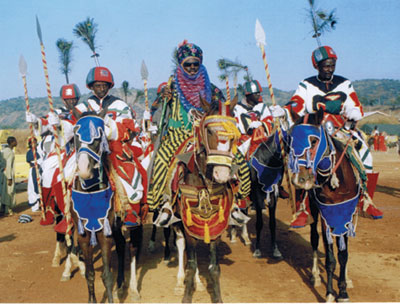
 reeds--something introduced by colonialists that everybody enjoys! The British took the concept of Indian displays of horsemanship, the product of Mogul courts, whispered about it to the Hausa emirs, and presto! A new form of royal entertainment was born.

 With Oliha's return from Nigeria, we're stepping up the African spirituality aspect of our sim, and, since this is a column rather than an article, I figure I can get personal with this material. I've had an interest in African spirituality since I was eleven and first read a Jorge Amado novel. I started making lists of Yoruba words and their translations (yes, yes, a curious child), and started the love affair that was to lead me to study African art.
 great
great
 kers tend to be aged, the shrines themselves thick in palace areas, but crowded out in many regions.
 metal--computers are now under his purview) and Shango, both popular in Yoruba movies about the supernatural. But none knew the deity of smallpox, Shopona (Omolu in Brazil, Obaluaiye in Cuba). One young man in his twenties recognized the name, but didn't know the association. "My grandmother used to curse me with that name when I misbehaved," he said. "But I didn't know who it was."

 African Fertility Rites: Illusion or Reality?
Africa, the birthplace of humanity. Mother Africa. It logically follows that civilization sprang out of African soil, as well as some of the first questions of life. So too was the study of the mystical sciences of the universe. African civilization has many blessings to offer the world. One of the most cherished blessings is fertility.
Fertility in African society was important for the continuation of the family and society, and provided access to becoming a revered ancestor. Fertility and childbirth were the keys to obtaining immortality. Africans love children for the many blessings that they bring.
A family is unable to continue if there are no surviving children to carry on its name and memories. Society will end if there are no children to keep it evolving. And one is unable to become an ancestor if there are no children to perform the funeral rites, and make the prayers and offerings.
Fertility is what turns a couple into a family. It takes at least three persons to make a nuclear family. Father, mother, and child. None of the above can be accomplished without fertility. In Nigeria, families gauge their prosperity by the number of children they have. Children are the joy of life!
To ensure fertility, many women go to shrines and take ritual baths, or use medicines, prayers, or amulets to ensure a fertile marriage. The shrines are sacred spaces devoted to a specific deity. Most fertility deities are associated with water. All life stems from the bountiful sea of life. Wealth is also associated with the great sea. 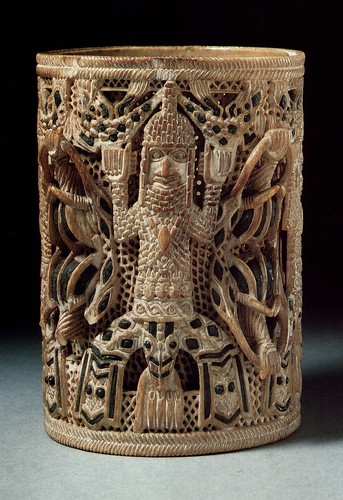
Some of the Nigerian deities who are associated with fertility are Olokun, Oshun, Yemaya, and Mami Wata. Olokun, god of fertility, is most known as the god of the seas. The seas represent where all life springs from. Olokun is also associated with wealth, as are children. Olokun is portrayed as a male deity in the Edo region and a female deity in most of the Yoruba regions.
Edo women keep Olokun shrines to ensure fertility and a good childbirth. Men also have Olokun shrines dedicated to wealth. Olokun’s colors are white, dark blue, red, coral, and green. Some of the tools that represent Olokun are white cloth, white chalk (kaolin), ladders, mirrors, cowries, and coral.
Oshun is a Yoruba female deity of maternity, love, wealth, the Oshun river and, in the diaspora, waterfalls and inland waters. The colors of Oshun are yellow, metallic gold, and brass. Her ritual tools include a brass fan and a brass comb. She is also associa

Yemaya is a patron deity of pregnant women, maternity and, in the diaspora, the ocean. Yemaya represents the mother of all living things. Yemaya’s colors are crystal, blue and occasionally touches of red. Her metal implements also include a fan, but in the diaspora it is usually a "white" metal, silver or tin.
Mami Wata exists in many parts of West and Central Africa. In Nigeria, she appears in Yoruba, Edo, and Igbo settings as a deity of water, fertility, healing, and wealth. Sometimes represented as a mermaid, also as fully human. Although Mami Wata is barren, she can give her devotees children upon supplication. Mami Wata’s colors are red and white.
Each deity has a form of divination that uses cowrie shells. Cowries come from the sea and are associated with water divinities. They are also associated with wealth, for they were used as a form of currency before the European conquest of Africa.
All of these Nigerian deities were brought to the Americas by African priests and priestesses. Coming this Thursday, you can find orisha and initiate’s clothesin Saminaka’s Adire store for devotees and potential married couples to wear and celebrate their fertility!
Saminka will also have an Olokun shrine, where fertility, love drawing, childbirth, divination, and naming ceremonies are performed by appointment. Many women who were once barren are now believers in the mystical powers of African fertility deities! Come and bathe in the healing waters of Olokun, and receive the blessing of life! Other shrines and products to come!


 Tues., Sept. 8, 6 pm SLT. Weekly meeting of Egbe Akowe Writers Group at the new Slates, Scrolls & Sticks, Saminaka's library cum bookstore. Join the group and receive its missives by hitting the Subscribe-o-Matic (it doesn't add to group count) at the meeting location. http://slurl.com/secondlife/Saminaka/174/194/30 or the Manatee Lookout Palm Wine Joint on Tarkwa Beach.
What do you think of when you hear the word “regatta”? Yachts with sails ballooning? Power boats full of laughing passengers, chugging in a line up the river? Well, abandon all those thoughts and paint yourself a new regatta! Nigeria’s riverine peoples have a tradition of decorating their canoes for exciting displays of color, dance and rhythmic paddle slapping.
West African canoes are dugouts, made from single hollowed tree trunks. In many countries—Ghana, Ivory Coast, Cameroon, Benin Republic, Togo—they are painted or otherwise ornamented with carved segments. Beach visitors are struck by their picturesque qualities, and Flickr is full of tourist shots of these attractive boats--but a flotilla of canoes with even more elaborate embellishments seems to be exclusively Nigerian.

Stanley noted a display of war canoes in 19th century Uganda: "The largest canoe seen by me in this fleet measured 72 feet in length, 7 feet three inches in breadth...There were probably over a hundred canoes between 50 and 70 feet in length, and about 50 between 30 and 50 feet long...The largest class--100 in number--would require on an average fifty men each to man them." The various Nigerian fleets were comparable

Regattas and festivals are a natural fit, so we want to have one for our African Festival! Through the kindness of Carricre Wind, we have a supply of modifiable simple dugouts. It is up to you, dear readers, to transform them from serviceable crafts to things of beauty, to staff them with similarly dressed friends and dancers or man them alone. Paint them, deck them with fluttering cloths, do what you will. They are available in a box at Saminaka’s infohub throughout September, so ready yourself! When the Festival event times are finalized, come and participate or watch, and be in the running for some splendid prizes!
Get a look at the real thing with this short video from the Ijo city-state of Nembe:
http://www.youtube.com/watch?v=ASWikKDouIQAnd pick up your canoe, ready for growth, painting and decoration at: http://slurl.com/secondlife/Saminaka/57/157/22


 Posts
All Comments
Posts
All Comments


